
I. Progress in Vaccine R&D and Approvals
- Approval of New-Platform Vaccines
DNA and RNA vaccines have developed very fast. These include viral vector vaccines and mRNA-LNP vaccines. Ten new viral vector vaccines have been approved since 2012. They work against diseases like Japanese encephalitis, dengue, Ebola and SARS-CoV-2. Two mRNA-LNP vaccines have also been approved. Vaccine manufacturing for these new platforms requires new equipment and skills.
Some viral vector vaccines use special designs. One example is heterologous vector systems, like GamEvac-Combi. They use different carriers such as VSV and Ad5 to carry antigens. Vaccine manufacturing has to handle these different carriers with care.
- New Developments in Traditional Vaccines
Flucelvax was approved in the United States in 2012. It was the first seasonal flu vaccine made with cell culture. It uses suspended MDCK cells. Europe approved this vaccine in 2007. Vaccine manufacturing for cell-based flu vaccines is different from egg-based methods.
The FDA approved several important vaccines in 2017. One is Shingrix. It is a recombinant glycoprotein vaccine. It is made in CHO cells and uses a special adjuvant. Another is Heplisav-B. It is a hepatitis B vaccine. It uses a new adjuvant and a recombinant protein antigen.
The FDA approved JYNNEOS in 2019. It is a vaccine for smallpox and monkeypox. It is a live vaccine from the MVA-BN strain. It grows in special cell lines and goes through many steps. Its use was expanded in 2022 under emergency approval.
The WHO supported new polio vaccines in 2020. One is nOPV2. It is made in Vero cells. It has gene changes. These changes make it more stable. Another is sIPV. It is made in Vero cells with microcarriers. It has many improvements. These improvements lower safety risks.
- Achievements in COVID-19 Vaccines
COVID-19 started in early 2020. Many vaccine candidates began clinical tests soon after. The first emergency use approvals came in December 2020. More than 13 billion doses were given by March 2023. Vaccine manufacturing at this scale had never been done before.
There are several main types of COVID-19 vaccines. One type is inactivated whole-virus vaccines. For example, CoronaVac by Sinovac and BBIBP-CorV by Sinopharm. Vaccine manufacturing for inactivated vaccines needs large virus culture and chemical killing. Another type is mRNA-LNP vaccines. For example, Comirnaty by Pfizer-BioNTech and Spikevax by Moderna. Vaccine manufacturing for mRNA-LNP vaccines uses pDNA templates and lipid nanoparticle mixing. The third type is adenoviral vector vaccines. For example, Vaxzevria by AstraZeneca and Ad5-nCoV by CanSino. These vaccines are different in many ways. They use different doses. They use different adjuvants. They use different cell lines. They use different storage conditions. Vaccine manufacturing has to adapt to all these differences.
II. Advances in Vaccine Production Technology
1、Cell Culture
- Adherent Cell Lines
People choose different cell lines for vaccine making over time. Safety is a main reason. More types of cell lines are allowed now. Continuous cell lines are used more often. Vaccine manufacturing benefits from these new cell line choices.
For example, the rVSVΔG-ZEBOV-GP Ebola vaccine is made in Vero cells. It uses a specially changed viral strain. Vaccine manufacturing for this Ebola vaccine uses adherent Vero cells in fixed-bed reactors.
New ideas have come out in single-use bioreactors. These include high surface-area-to-volume SUBs and fixed-bed reactors. These are combined with more intense and automated single-use bioprocessing. Polio vaccine production shows the full workflow from cell culture to viral killing. Vaccine manufacturing now uses single-use systems more and more.
- Suspension Culture
Suspension culture is used a lot in vaccine making. For example, insect cell suspension culture (Sf9) uses the baculovirus system. It is used for large-scale production of influenza HA protein. Vaccine manufacturing for flu vaccines can use this insect cell system.
Cell lines like Vero and PER.C6 can be changed to grow in suspension for virus production. Better CHO cell culture technology helps make vaccines. This is shown in work on SARS-CoV-2 vaccine candidates by Watterson and others. It also helps make the VZV glycoprotein E used in Shingrix. Vaccine manufacturing for Shingrix uses CHO cells in suspension.
During the COVID-19 pandemic, vaccines from the University of Oxford used a replication-deficient adenoviral platform. These were successfully made at large scale. Suspension cell culture was used to make adenoviral vectors. These vectors carry the spike protein.This allowed large-scale vaccine supply. Vaccine manufacturing for adenoviral vector COVID-19 vaccines reached billions of doses.
2. Microbial Production
- Traditional Applications and New Progress
Microbial fermentation platforms help make many vaccines. For example, Saccharomyces cerevisiae makes the HPV L1 protein. This protein builds itself into VLPs to form the Gardasil vaccine. Hepatitis B surface antigen can be made in Saccharomyces cerevisiae or Pichia pastoris. Pneumococcal conjugate vaccines are made by linking polysaccharides from certain bacteria to carrier proteins. Vaccine manufacturing for conjugate vaccines needs bacterial fermentation and chemical linking.
New culture systems have grown fast. The Dyadic platform uses a fungus called Thermothelomyces heterothallica. It allows quick development of stable strains with high yields. It is easy to scale up and low in cost. A COVID-19 vaccine candidate made in this system is now in clinical tests. MIT’s automated Pichia pastoris platform can make many different proteins, including vaccine antigens. It is now used to make a rotavirus vaccine candidate. Vaccine manufacturing for rotavirus is being done on this automated platform.
Making protein antigens has a problem. It is hard to show the key protective epitopes. In mRNA vaccine making, E. coli fermentation is the main way to make pDNA templates. Cell-free pDNA synthesis has gotten better. But its cost is still too high. Strain choice and sequence design are very important for pDNA production. New ways to make conjugate vaccines have also come out. Vaccine manufacturing continues to improve with new methods.
- Equipment Innovation and Trends
Fermentation equipment has moved from stainless steel pressure vessels to biorreactores de un solo uso. Single-use systems have many good points. They remove cleaning and sterilization steps. They make work more flexible. But they can only go up to about 3,000 L because of process limits.

Single-use options are now used in many purification steps. These include depth filtration and chromatography columns. Vaccine makers are building a reliable supplier network for single-use systems. The industry is also pushing for recycling and circular economy plans for single-use parts.
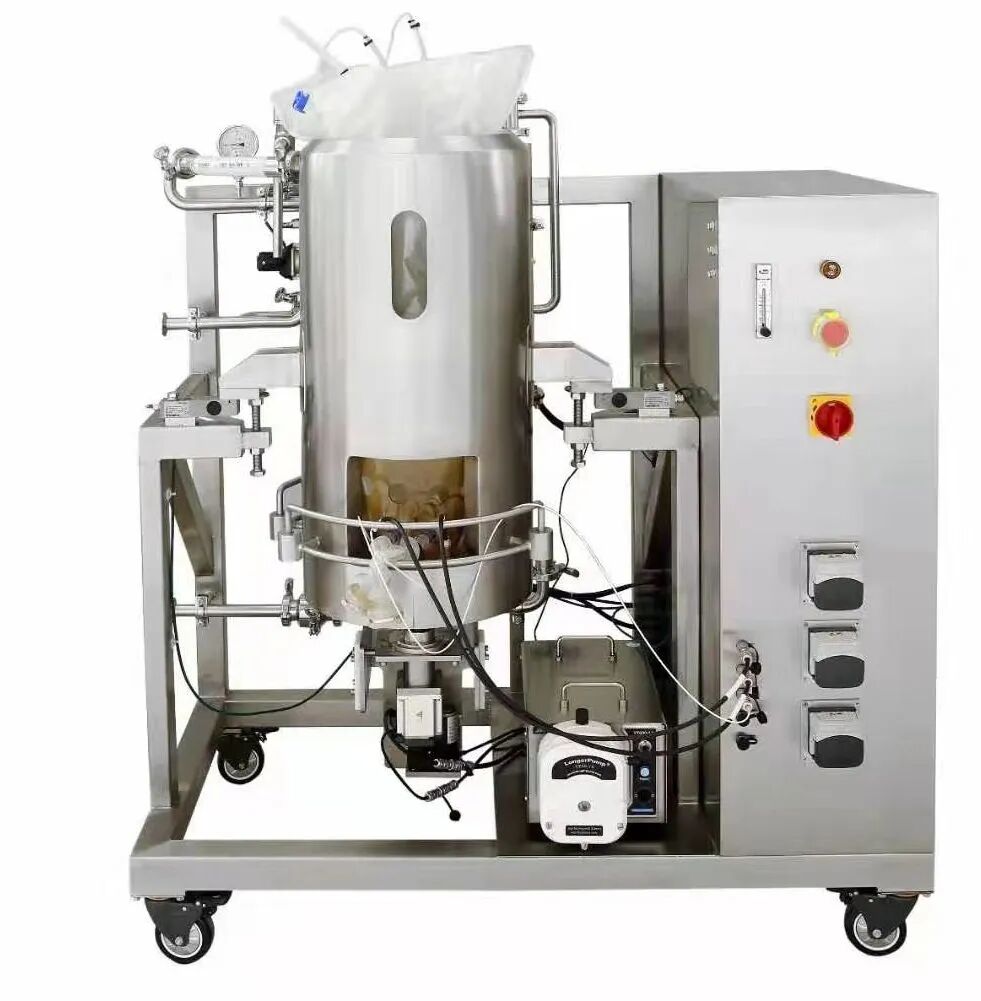
As a manufacturer/factory with over 25 years of experience in bioreactor and pressure vessel production, Bailun has established itself as a leader in China’s vaccine equipment sector, meeting global technical standards . The company’s core strengths align with the industry’s evolving needs:
- Customization Capabilities: Bailun offers tailored solutions for laboratory, pilot, and industrial-scale vaccine production, with bioreactor volumes ranging from 0.1L to 1000KL . Its product portfolio includes stirred-tank bioreactors, single-use systems (e.g., SKC 900 series), and specialized vaccine bioreactors (BL BIO-XS series) that support both adherent and suspension cell cultures . Customizable features include control systems (Siemens PLC, multi-language touch screens), sensor configurations (pH, DO, biomass), and process integration (CIP/SIP systems) .
- GMP/CE Compliance: Bailun’s equipment meets strict international regulatory requirements, including GMP (FDA, EU, TGA, CFDA), CE, ASME U Stamp, and PED certifications . All liquid-contact parts use SS316L stainless steel with precision polishing (0.2-0.4μm), ensuring sterility and product safety . The company provides full validation documentation and compliance consulting to support vaccine manufacturers’ regulatory submissions .
- Turnkey Solutions: Bailun delivers end-to-end services, from process design and equipment manufacturing to on-site installation, commissioning, and after-sales support . Its integrated offerings include upstream (fermenters, bioreactors), downstream (purification systems), and auxiliary equipment (CIP stations, steam generators), enabling seamless workflow integration for projects like 10KL yeast fermentation plants or 20KL GMP workshops . The company’s technical team—comprising bioprocess engineers, mechanical experts, and automation specialists—collaborates with customers to optimize production efficiency .
- Price Advantage: Despite its advanced technology and compliance capabilities, Bailun maintains competitive pricing for both standard and customized equipment . It also offers cost-effective spare parts and flexible budget options (e.g., manual/semi-automatic CIP systems) without compromising quality .
Sobre Bailun
Bailun has a lot of experience in making reactors and pressure vessels. It has a skilled team that covers bioreaction, fermentation technology, mechanical engineering, and automatic control. Bailun stays ahead in China and meets world standards in research and process technology. We give customers a good, safe, and reliable product experience. Contáctenos