
In the process of penicillin fermentation, the maximum biological yield is usually achieved by screening superior strains, regulating biological processes such as the metabolic development and growth of bacterial cells, and providing the optimal pH, temperature, as well as carbon and nitrogen sources in the fermentation broth.

These control conditions, along with various biological, physical-chemical and engineering environmental factors, exert a significant impact on the above processes. Therefore, studying the culture rules of bacterial cells, external control factors and methods to achieve optimal results has become an important task in fermentation engineering.
一、Overview
The fermentation process is different from the chemical reaction process. It involves both the life processes of the growth, physiology and reproduction of biological cells, and the multi-enzyme reaction processes catalyzed by various enzymes secreted by microbial cells and their influencing factors. Thus, fermentation is a comprehensive application of the theories and technologies of microbiology, chemistry, engineering and other disciplines. Due to the complexity of the fermentation process, it is rather difficult to control, especially for the fermentation of secondary metabolites such as penicillin.

二、Applications and Main Production Process of Penicillin
It is an antibiotic extracted from the culture broth of Penicillium species, and it is the first antibiotic capable of treating human diseases. As a bactericidal agent, pcn mainly acts on most Gram-positive bacteria, Gram-negative cocci, spirochetes and actinomycetes. It inhibits peptidoglycan synthesis, resulting in cell wall defects. Since susceptible bacteria have high internal osmotic pressure, water continuously infiltrates into the cells, causing the bacteria to swell, rupture and eventually die.
The bactericidal characteristics of penicillin are as follows:
- It has a strong effect on Gram-positive bacteria but a weak effect on Gram-negative bacteria. 2. It acts on bacteria in the logarithmic growth phase but has no effect on those in the stationary phase. 3. Because mammalian and fungal cells do not have cell walls, ithas low toxicity to humans and is ineffective against fungi. Production Process: Lyophilized spores → Agar slant → Rice spores → Seed tank → Fermentation tank → Filtration → Butyl acetate extraction → Dehydration and decolorization → Crystallization → Crystal washing → Industrial salt → Mycelium → Comprehensive utilization. During the fermentation process, carbon sources, nitrogen sources, precursors and defoamers are added.
三、Breeding of Penicillin-producing Strains
3.1 Selection of Original Strains
Penicillin-producing strains are mainly Penicillium chrysogenum 51-20 and Penicillium notatum. With Penicillium chrysogenum 51-20 as the parent strain, high-yield strains with a pcn yield of over 30,000 u/ml have been obtained through continuous mutagenesis. Penicillium exhibits certain morphological characteristics on solid media. At the initial stage of growth, spores swell first, germinate to form germ tubes that elongate rapidly, develop septa, reproduce to form hyphae, and then produce complex branches that interweave to form colonies.
Colonies may appear flat or highly wrinkled. On a medium with uniform nutrient distribution, colonies are generally circular, with edges that can be regular, serrated or fan-shaped. During development, conidiophores with sterigmata and metulae grow from aerial hyphae, and conidia are produced on the metulae, arranged in chains and shaped like a brush, which is called a penicillus.
Conidia are yellowish-green, green or blue, and turn yellowish-brown, reddish-brown or gray when aged. Conidia can be elliptical, cylindrical or spherical, and each strain has a specific conidial morphology that remains unchanged after multiple subcultures. Conidia are generally not produced in submerged culture.
3.2 Blocking Branch Metabolic Pathways
When the primary metabolism and secondary metabolism of a strain follow branched pathways, auxotrophic mutants of primary metabolites can often increase the yield of corresponding secondary metabolites. For example, researchers obtained a leucine auxotrophic mutant through mutagenesis, which increased the pcn yield by four times.
The biosynthesis of it is subject to feedback inhibition by lysine, because lysine can inhibit or repress homocitrate synthesis. Therefore, by using lysine auxotrophic mutants and adding lysine to the medium, the pcn yield can be significantly improved.
3.3 Breeding of Structural Analogue-resistant Mutants
(1) Screening of Self-tolerant Mutants
Strains with different activities have varying degrees of self-tolerance, and high-yield strains can tolerate high concentrations of self-produced antibiotics. For this reason, self-produced antibiotics can be used to breed high-yield strains. For example, researchers screened a mutant strain that can tolerate 100,000 u/ml of pcn V, increasing the fermentation titer of pcn to approximately 40,000 u/ml. This type of self-tolerant mutant may have relieved feedback inhibition, greatly enhancing the activity of pcn synthetase and thus promoting the synthesis of penicillin V.
- Screening of Precursor or Precursor Analogue-resistant Mutants
Toxic precursors or their analogues can inhibit the growth of certain microorganisms and the biosynthesis of metabolic products. Breeding resistant strains to toxic precursors and their analogues can eliminate their inhibitory effects on microbial growth and the biosynthesis of final products, thereby increasing the yield of final products. Using phenoxyacetic acid as the precursor for pcn fermentation, a mutant strain resistant to 1.3% phenoxyacetic acid was selected, and the fermentation titer of penicillin V reached 50,000 u/ml. In addition, breeding mutants resistant to phenylacetic acid and phenylacetamide can also significantly improve pcn yield.
- Breeding of Revertants of Auxotrophic Mutants
Researchers obtained a pcn high-yield strain with a titer twice that of the parent strain by first mutating a prototrophic strain into an auxotrophic mutant and then mutating it back into a prototrophic strain. When a primary metabolite serves as the precursor of a secondary metabolite, revertants of auxotrophic mutants of this primary metabolite may be an effective way to obtain high-yield strains. For example, researchers obtained a revertant of an α-aminoadipic acid auxotrophic mutant through mutagenesis, which increased the pcn yield by 2.4 times. In addition, breeding revertants of cysteine auxotrophic mutants, isoleucine auxotrophic mutants and threonine auxotrophic mutants can all significantly increase pcn yield.
4 Increasing Precursor Synthesis
Valine is a precursor for penicillin synthesis. As mentioned earlier, acetohydroxy acid synthase converts pyruvate into acetolactic acid, which eventually forms valine. However, excessive valine can feedback-inhibit acetohydroxy acid synthase. Through mutagenesis, a high-yield Penicillium chrysogenum strain was bred, in which the feedback inhibition of acetohydroxy acid synthase by L-valine is much weaker than that in the parent strain. This allows the cells to accumulate more valine, resulting in a significant increase in pcn yield.
5 Breeding of Morphological Mutants
During long-term breeding, it was found that as the penicillin yield gradually increased, the colony diameter gradually decreased, the surface structure of the mycelium changed from flat to wrinkled, and the number of spores gradually reduced. In submerged culture, cephalosporin-producing strains exhibit various morphologies such as hyphae, arthrospores and conidia. The transition of hyphae from the differentiation stage to the arthrospore stage is directly consistent with the maximum rate of β-lactam antibiotic synthesis. As the number of arthrospores in the fermentation broth increases, the antibiotic activity also increases. Therefore, high-yield penicillin strains can be obtained by selecting morphological mutants.
6 Other Markers
- Screening of Growth Inhibitor-resistant Mutants
In the breeding of Penicillium and Cephalosporium strains, the method of screening heavy metal ion-resistant mutants is often used. Heavy metal ions are toxic in themselves, but their toxicity can be eliminated by binding to it, resulting in resistant strains that can improve antibiotic yield.
- Screening of Defoamer-tolerant Strains In penicillin production, a large amount of vegetable oil is consumed. To reduce vegetable oil consumption, high-yield mutants tolerant to synthetic defoamers can be screened. The method is to add synthetic defoamers to the medium and select high-yield strains that are tolerant to defoamers for production.
- Breeding of Strains with Good Cell Membrane Permeability Researchers obtained a Penicillium chrysogenummutant with altered cell membrane permeability through mutagenesis. It was found that the mutant’s ability to uptake inorganic sulfate was two to three times higher than that of the parent strain, and it could reduce the regulatory control of inorganic sulfur, thus effectively converting it into cysteine. As a result, the penicillin yield was increased by 2.4 times.
- Construction of Genetically Engineered Strains Soviet scientists used genetic engineering technology to clone and enhance the pcnG acylase gene, strengthening the penicillin biosynthesis ability. The constructed engineered strain increased the pcn yield by 3.3 times.

四、Optimization and Control of Fermentation
- Carbon Sources
It can utilize a variety of carbon sources, such as lactose, sucrose, glucose, arabinose, msi四、annose, starch and natural oils. Lactose is the best carbon source for penicillin biosynthesis, and glucose is also a good carbon source, but its addition concentration must be well controlled. This is because glucose is easily oxidized by bacterial cells and produces substances that inhibit the formation of antibiotic synthetase, thereby affecting pcn synthesis. Therefore, the method of continuous glucose feeding is used instead of lactose.
Phenylacetic acid or its derivatives such as phenylacetamide, phenethylamine and phenylacetylglycine can all serve as side chain precursors for penicillin G. The mycelium utilizes precursors through two pathways: direct incorporation into product molecules, or utilization as nutrients and energy sources, i.e., oxidation to carbon dioxide and water. The pathway through which precursors are utilized by the mycelium mainly depends on the culture conditions and the characteristics of the strain used. For example, the early-adopted strain Q-176 oxidizes and consumes most of the precursors (71%-94%), with only 2%-10% converted into it.
In contrast, strains used in modern industry have a precursor conversion rate of 46%-90%. To avoid the toxic effect of excessively high precursor concentration on the mycelium, besides adding 0.07% of the precursor to the basal medium, the remaining amount is supplemented together with nitrogen sources as needed.
Lurie et al. compared the toxicity of phenylacetamide, phenylacetic acid and phenoxyacetic acid. Except for phenoxyacetic acid, the toxicity of phenylacetamide and phenylacetic acid depends on the pH of the medium and the precursor concentration. Phenylacetamide is toxic under alkaline conditions and inhibits mold growth at pH 8; phenylacetic acid is more toxic under acidic conditions (pH 5.5) but does not inhibit mycelial growth under alkaline conditions. When the medium pH is neutral, phenylacetamide is more toxic than phenylacetic acid.
When the precursor dosage exceeds 0.1%, the biosynthesis of it decreases except for phenoxyacetic acid, especially with phenylacetamide. It is generally believed that the precursor concentration in the fermentation broth should be maintained at 0.1% at all times.
Under alkaline conditions, the oxidation rate of phenylacetic acid by the mycelium increases with the increase of medium pH. Young hyphae do not oxidize precursors but only use them to form penicillin molecules. As the mycelium ages, its oxidation capacity gradually increases. The composition of the medium has a significant impact on the oxidation degree of precursors; synthetic media result in less precursor oxidation than complex media. In shake flask fermentation experiments, it was found that under poor aeration conditions, the ability of microorganisms to oxidize precursors decreased significantly.
To reduce the oxidation of phenylacetic acid, intermittent or continuous feeding of low-concentration phenylacetic acid is widely used in production to maintain the precursor supply rate slightly higher than the requirement for biosynthesis. It has been reported that tablets made by compressing sucrose and sodium phenylacetate are used for intermittent feeding in pcn shake flask fermentation. The contents of these tablets are slowly released in the solution to control the release time and rate. Using this method, after 9 days of fermentation, the penicillin titer can reach as high as 16,150 u/ml.
4.2 pH
During penicillin fermentation, pH is controlled by the following methods: if the pH is too high, sugars, sulfuric acid and inorganic nitrogen sources are added; if the pH is too low, calcium carbonate, sodium hydroxide, ammonia or urea are added. An automatic acid-base addition system can also be used to maintain the fermentation broth pH at 6.8~7.2 to increase pcn yield. It has been reported that controlling pH by sugar feeding is better than by acid-base addition.
One method is to adopt constant-rate sugar feeding and use acid-base to control pH; another method is to adjust sugar feeding according to pH, i.e., feed more when pH rises rapidly and less when pH drops, to maintain the pH within the range of 6.6~6.9.
4.3Temperature
The optimal temperature for the growth of Penicillium is 30℃, while the optimal temperature for penicillin secretion is about 20℃. In production, a variable temperature control method is adopted to meet the requirements of different stages. For example, adopting a fermentation temperature that gradually decreases from 26℃ to 22℃ can delay mycelial senescence, increase the dissolved oxygen concentration in the culture broth, prolong the fermentation cycle, and facilitate the increase of penicillin titer in the later stage of fermentation.
Constantinides et al. conducted research on batch penicillin fermentation and carried out fermentation experiments using the obtained experimental data: maintaining the temperature at 27.2℃ for 0~56h, then decreasing the temperature to 18.7℃ at a constant rate and maintaining it until 184h, and finally returning to 27.2℃ for the last 24h of culture. Using this variable temperature culture method, the yield increased by 16% compared with that of normal temperature culture at 25℃.
4.4Feeding
During fermentation, in addition to controlling sugar concentration and pH through intermediate sugar feeding, supplementing nitrogen sources can also increase the fermentation titer. Experiments have confirmed that if ammonium sulfate is added in batches starting from 60~70h of fermentation, the nitrogen content of the mycelium hardly decreases after 90h, maintaining at 6%~7%, and 60%~70% of the mycelium is in the young stage.
The mycelial respiration intensity is maintained at a CO₂ production rate of 16 µl/(mg mycelium·h), and the antibiotic yield stops increasing, with the total yield only half of that in the test tank. Therefore, to prolong the fermentation cycle and increase penicillin yield, batch feeding of nitrogen sources during fermentation is also an effective measure.
For another example, adding 0.05% urea to the basal medium and adding urea twice during sugar feeding can reverse the situation of thinning fermentation broth, low pH and slow increase of penicillin titer.
Adding surfactants together with the feed liquid during fermentation, such as 50mg/l of benzalkonium bromide, or non-ionic surfactants such as polyoxyethylene, monooleate and trioleate, can also increase penicillin yield.
Adding a small amount of soluble polymer compounds during penicillin fermentation, such as 40mg/l of polyvinyl alcohol, sodium polyacrylate and polydiethylamine, can increase the penicillin yield by 38%.
The reasons why these substances can improve the yield are as follows:
- When the fermenter uses high stirring power and high impeller tip speed, these polymer compounds can reduce the liquid velocity gradient near the stirring impeller, avoid breaking the hyphae, and promote the full dissolution of oxygen in the medium while facilitating the removal of CO₂.
- During mycelial growth, these polymer compounds act as dispersants, preventing the hyphae from clumping together and increasing the interface area, thus increasing the total rate of oxygen transfer into the mycelial cells.
4.5 Effect of Iron Ions
Trivalent iron ions have a significant impact on penicillin biosynthesis. Generally, if the Fe³⁺ content in the fermentation broth exceeds 30~40ug/ml, the increase of fermentation titer will be slow. Therefore, iron tanks must be treated before use, and a protective layer such as epoxy resin can be coated on the tank to control the Fe³⁺ content below 30ug/ml. Based on the above condition controls, combined with workers’ experience, relatively ideal results can be obtained in actual production.
About Bailun
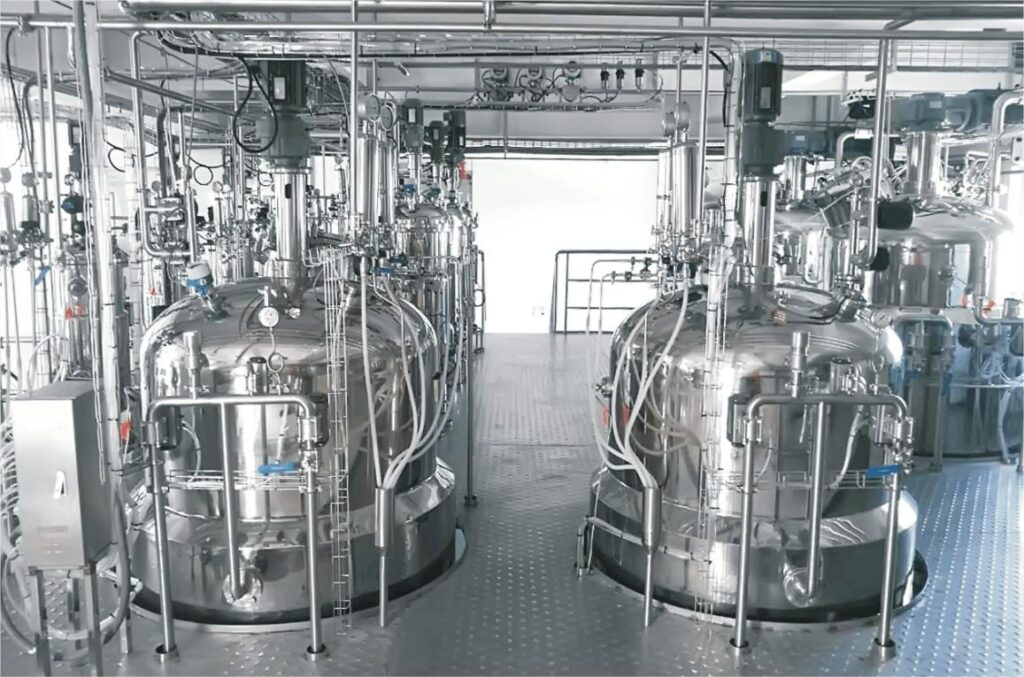
Bailun has rich experience in the manufacturing of various reactors and pressure vessels. We have a team of experts in the fields of biological reaction, fermentation technology, mechanical manufacturing and automatic control. Our scientific research and technological level are always at the leading domestic and world-class level, providing you with satisfactory, reliable and reassuring product experience. Contact us