
I. System Design Principle and Composition
A biological process refers to the biochemical reaction carried out by a biological system inside a bioreactor. The biological system and its surrounding environment in the bioreactor form a relatively closed ecosystem.

In this ecosystem, there are interactions between the biological system and environmental factors. For a biological system, especially one with cells as the main body, its phenotype is closely related not only to its genotype, but also to the micro and macro environmental conditions where cells live, including nutrient types, pH, temperature, dissolved oxygen, and the mixing and transfer characteristics of the bioreactor. In other words, genotype and environment jointly determine the phenotypic characteristics of the biological system.
On the other hand, biological processes are highly nonlinear and time-varying. It is difficult to characterize their complex inherent properties with macroscopic kinetics designed only for the detection and control of environmental operating parameters. Therefore, it is necessary to systematically analyze cellular metabolic changes combined with the metabolic characteristics related to parameters during fermentation. It should be emphasized that the correlation between cell physiological status and process parameters is the result of material, energy or information transfer, conversion and balance in the bioreactor.
Although the microscopic influencing factors may only occur at one scale, such as the gene, enzyme, cell or bioreactor level, they will eventually be reflected in the macroscopic process. This provides a clue for studying the multi-scale data correlation analysis method in bioreactors.
An ideal bioreactor system should detect and analyze operating parameters and state parameters at different scales as much as possible. In this way, it is possible to construct an optimized external environment, so that microbial gene expression and metabolic regulation are most conducive to the biosynthesis of target products, and the accumulation of target products can be maximized.
The above illustrates the engineering scientific issues of biological processes. The research has evolved from macroscopic kinetics to multi-scale theoretical methods based on biological process information processing, which guides the development of bioreactor-centered engineering technologies related to biological processes.

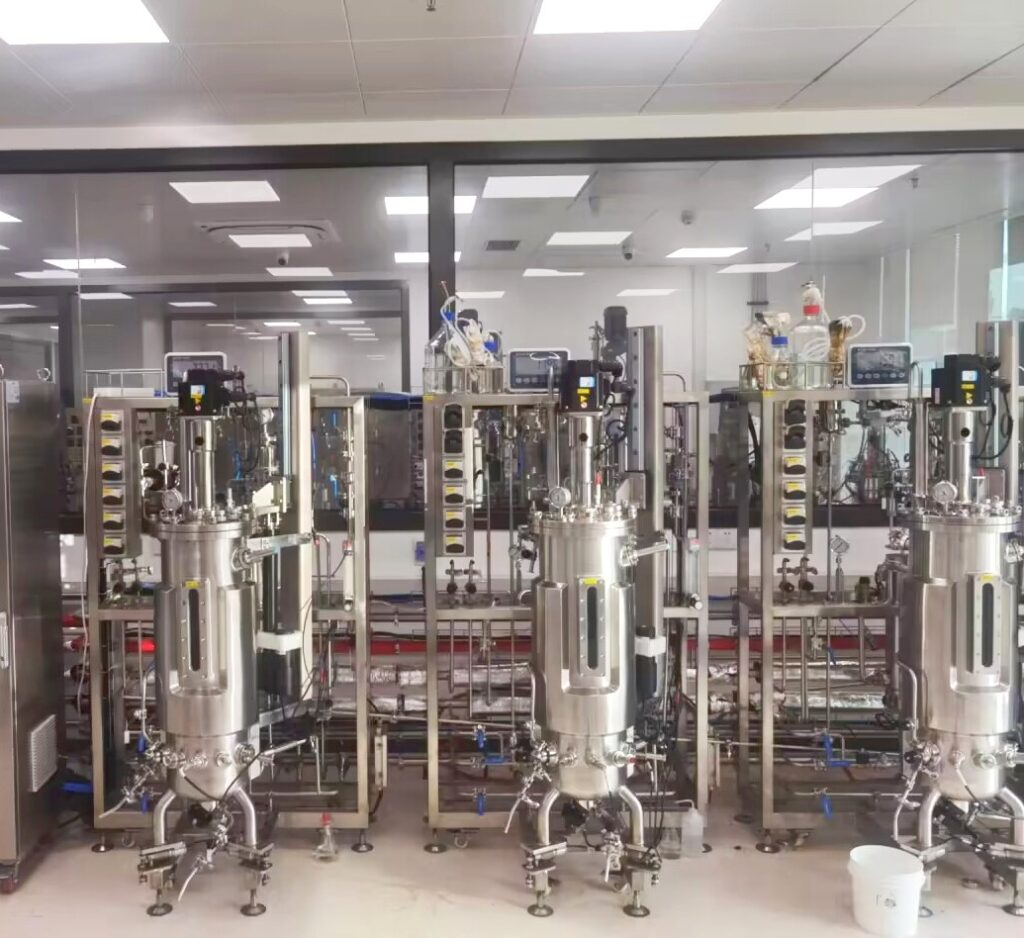
Bailun has developed a multi-scale bioreactor system based on metabolic flux. This system includes advanced sensors for detecting cellular physiological and metabolic characteristics, a sensing bioreactor and control system for microscopic metabolic flux analysis of biological processes, a computer software package suitable for correlation analysis of cellular physiological and metabolic parameters, and a computer internet system for fermentation process data processing and remote analysis.
This system is equipped to the same high standard as top-tier systems in Europe. It reduces the interference of human factors on scientific research, improves data repeatability and accuracy, and lowers labor and material costs. It supports computer-based remote control and wireless monitoring without dedicated on-duty personnel. It is equipped with an automatic tank lid opening system, and all parameters can be automatically controlled.
The system can obtain as much biological information at various scales of bioprocessing as possible. Based on the multi-scale parameter correlation principle, it uses computer software for real-time data processing to identify key parameters for process optimization from massive data according to parameter correlation characteristics. These key parameters are then used to guide process operation, equipment design, or strain screening and modification, ultimately achieving process optimization and scale-up.
The system has been successfully applied to the process optimization of various products, greatly improving fermentation yield. The optimized process can usually be directly scaled up from laboratory fermenters of dozens of liters to industrial production fermenters of hundreds of cubic meters.

II. Development and Application of Advanced On-Line Instruments
On-Line Sensors
The bioreactor system centered on metabolic flux analysis is equipped with an advanced sensing system. In addition to conventional detection and control parameters such as pH, temperature, stirring speed, dissolved oxygen and rotameters, it is also equipped with thermal mass flow meters for accurate measurement and control of intake air flow, which ensures stability unaffected by intake air pressure, fermentation broth weighing systems, exhaust gas oxygen and carbon dioxide analyzers (exhaust gas component analyzers or process exhaust gas mass spectrometers), and top-mounted silicone oil pressure sensors, all to accurately measure the oxygen uptake rate (OUR) and carbon dioxide evolution rate (CER) of biological processes.
It can also be equipped with on-line sensors such as a sensing bioreactor and control system for microscopic metabolic flux analysis, an in-situ on-line viable cell concentration analyzer, and an on-line cell morphology microscope as required. Based on the directly measured parameters, important physiological and metabolic state parameters such as CER, OUR and respiratory quotient (RQ) can be calculated through the computer software package for correlation analysis of cellular physiological and metabolic parameters.
Exhaust Gas Mass Spectrometer
The process exhaust gas mass spectrometer is mainly used to measure the concentrations of O2, CO2 and N2 in exhaust gas. This mass spectrometer adopts an electron impact ion source. After on-line pretreatment, exhaust gas from different fermenters is continuously fed into the ionization chamber through a multi-channel rotary valve to form ions. According to the motion law of charged particles in an electric field, the quadrupole mass analyzer separates ions generated by the ion source according to their mass-to-charge ratio (m/z). It measures the ion mass intensity distribution to obtain information on compound types and concentrations, and accurately reflects changes in fermentation exhaust gas components.
Measurement results can be imported into a dedicated software package designed for fermentation processes to realize correlation analysis with other fermentation parameters. The exhaust gas mass spectrometer can detect volatile gas components with a relative molecular mass below 300, so it can also monitor small molecular substances such as ethanol and methanol according to fermentation needs.
Measurement Analyzers
Biomass is a key parameter in fermentation processes. At present, it is usually measured offline through classical methods such as dry weight and turbidity. The in-situ on-line viable cell concentration analyzer not only enables instant on-line measurement, but also obtains viable cell concentration with richer biological significance. It is especially suitable for fermentation processes where the culture medium contains insoluble solid substances.
The working principle of the viable cell analyzer is based on the non-conductive polarization of cell surfaces such as cell membranes in fermentation broth under an alternating electric field with a frequency ranging from 0.1 MHz to 10 MHz. Viable cells with intact protoplast membranes basically act as capacitors, since the non-conductive nature of lipid protoplast membranes leads to charge accumulation. In contrast, dead cells, lysed cells, cell debris, bubbles and other matrix components are barely polarizable. An alternating electric field in the above frequency range is applied through dual electrodes. The capacitance measured between the two electrodes depends on cell type and cell size, and is proportional to viable cell concentration within a certain range.
The in-situ on-line viable cell concentration analyzer is applicable to various animal and plant cells, yeasts, bacteria, algae and so on. However, it is not suitable for fermentation processes that use acid or alkali as neutralizers for target products, because excessive ionic strength in the fermentation broth will interfere with accurate capacitance measurement.
О Bailun
Bailun has rich experience in the manufacturing of various bioreactors and pressure vessels. It has an expert team integrating biological reaction, fermentation technology, mechanical manufacturing and automatic control. Its scientific research and technological level maintains a leading position in China and first-class international standards, providing you with comfortable, reliable and reassuring product experience. Связаться с нами