
An authoritative review published in Chemical Engineering & Technology systematically sorts out the core control strategies of fermentation processes, from basic open-loop to advanced intelligent control, providing a clear technical blueprint for industrial production.
This review paper, published in Chemical Engineering Technology, systematically summarizes the core challenges and technological frontiers of fermentation process control. The difficulty in controlling fermentation processes mainly stems from three core challenges:
- High Nonlinearity and Complexity: The growth and metabolic behaviors of microorganisms are not uniform linear processes but complex ones with “temperaments”. Even slight changes in temperature or pH value may cause them to “switch” metabolic pathways and produce completely different products.
- Cognitive “Black Box”: Our understanding of the complex biochemical reaction mechanisms inside microorganisms is still incomplete. It is like facing a partially transparent black box, making it difficult to establish accurate mathematical models to predict each step of their behavior.
- Lag in Measuring Tools: The lack of reliable, economical sensors capable of real-time online monitoring of key indicators (such as specific cell concentration and product concentration) results in the control system being unable to obtain timely feedback.
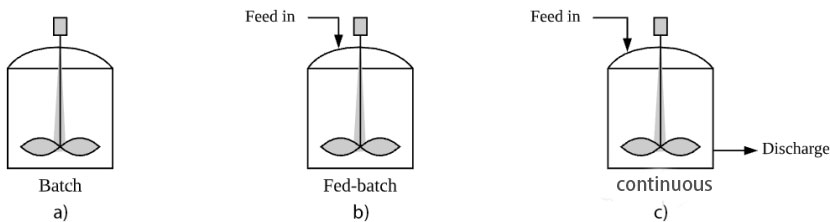
Fermentation Modes: Batch, Fed-Batch, and Continuous Production
Before selecting a control strategy, it is first necessary to understand the three basic “operational modes” of fermentation, each with its own advantages and disadvantages, suitable for different scenarios.
- Batch Fermentation: All materials are added at one time, and the product is harvested all at once after completion. Advantages: Simple operation and low contamination risk; Disadvantages: Low product yield and long preparation time between batches.
- Fed-Batch Fermentation: Fresh medium is continuously added during the process without discharging the product. Advantages: Avoids substrate inhibition, improves yield, and controls by-products; Disadvantages: Complex feeding strategy and potential genetic instability.
- Continuous Fermentation: Continuous feeding and discharging are carried out to maintain a constant volume in the reactor. Advantages: High yield and no downtime; Disadvantages: Complex downstream processing, high contamination risk, and easy occurrence of genetic instability.
To address these challenges, engineers have developed a variety of advanced control strategies, which are like commanders with different styles.
1. Model Predictive Control (MPC) – A Forward-Thinking Planner
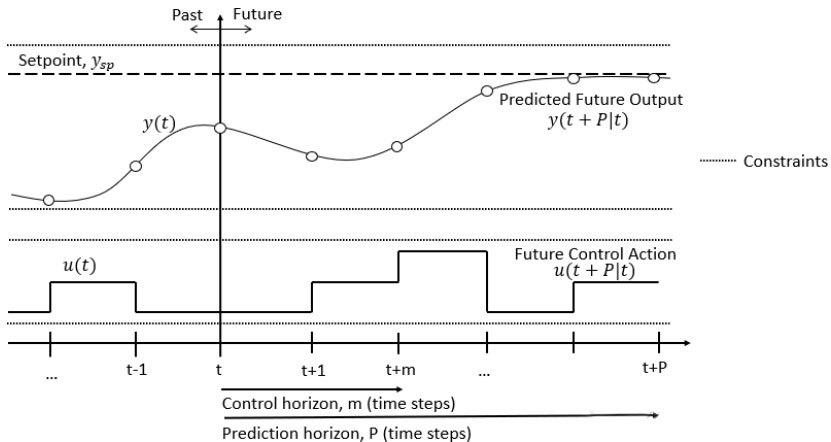
MPC is an advanced control strategy widely used in industry. Its core idea is to predict the future and optimize the present.
- Working Principle: MPC uses a mathematical model of the process to predict how key parameters will change over a future period (prediction horizon). It then calculates a series of optimal control actions (such as adjusting the feeding rate) but only implements the first step. In the next step, the system updates the prediction based on the latest actual measurements and recalculates the optimization, proceeding in a rolling manner.
- Advantages: Can “foresee” future changes, take actions in advance, and directly handle various constraints.
- Challenges: Its performance is highly dependent on the accuracy of the model, and the computational load is relatively large.
- As mentioned in the paper, NMPC (Nonlinear Model Predictive Control) has shown better performance than traditional control in penicillin production and glutamic acid fermentation, achieving higher final product
2. Fuzzy Logic Control – An Experienced “Master Craftsman”
Fuzzy logic control does not rely on precise mathematical models but imitates the experience and thinking of human experts.
- Working Principle: It converts vague linguistic descriptions such as “the water temperature is a bit high” and “the feeding is too fast” into rules that computers can process. The system decides how to operate through a series of “if…then…” rules.
- Advantages: Very effective for complex nonlinear systems that are difficult to model accurately, with strong robustness.
- Challenges: The establishment of the rule base relies on expert knowledge, and it lacks learning ability itself.

3. Metaheuristic Algorithms – Nature’s “Optimization Experts”
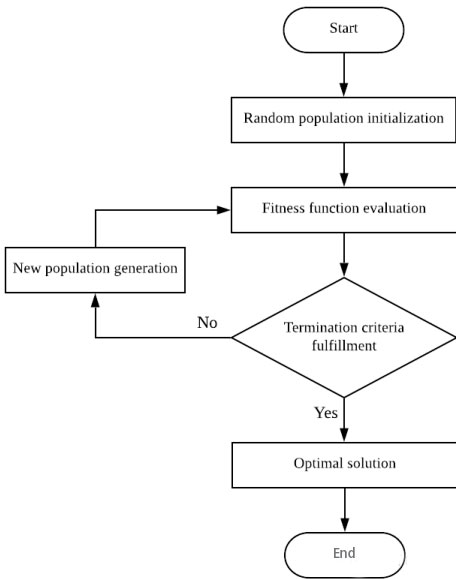
- Working Principle: Taking the genetic algorithm as an example, it encodes possible solutions into “chromosomes”, and through simulating natural evolutionary processes such as “selection, crossover, and mutation”, eliminates poor solutions and retains excellent ones from generation to generation, ultimately approaching the global optimum.
- Advantages: Does not depend on the specific mathematical properties of the problem, has wide applicability, and can handle complex constraints.
- Challenges: May fall into local optima and has high computational cost.
4. Artificial Neural Networks (ANNs) and Reinforcement Learning (RL) – AI with “Learning” Capabilities
- Artificial Neural Networks: Simulate the human brain’s neural network, and through training with a large amount of data, self-learn the complex relationships between inputs and outputs. It can be used both to establish soft sensors and directly as a controller.
Reinforcement Learning: Simulates the “trial-and-error learning” mechanism. An RL agent learns the optimal strategy through interaction with the environment and based on the results of its actions (rewards or punishments). It is like training a pet: giving rewards for correct actions and punishments for wrong ones, and it can eventually learn to complete complex tasks.
关于百伦
Bailun advances intelligent bioreactor technologies by building large-scale bioreaction models and an end-to-end synthetic biology platform spanning from strain development to industrial production. It establishes a precision fermentation big-data cloud that aggregates massive reaction data for real-time monitoring, analysis, and prediction of fermentation parameters and material changes, enhancing the efficiency and accuracy of synthetic biology R&D and driving the bioindustry toward intelligent, efficient, and sustainable development. 联系我们